

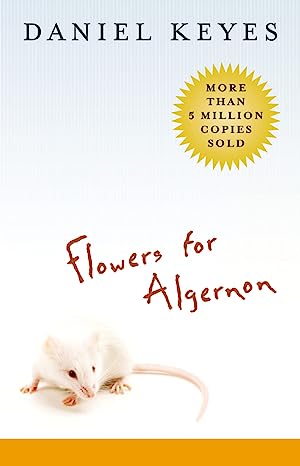


Flowers for Algernon(1966)
Daniel Keyes
Goodreads
4.24
796K VotesReadings
The compelling story of Charlie Gordon. willing victim of a strange experiment - a moron, a genius, a man in search of himself.
Infos
Pages
219
219
Authors
Format
ebook
ebook
Language
English
English
People Finished
4
4
Published By
Mariner Books
Mariner Books
Published at
4/1/1966
4/1/1966
Setting
New York City, New York (United States), New York (State) (United States), The United States of America
New York City, New York (United States), New York (State) (United States), The United States of America
Originally published at
4/1/1966
4/1/1966
Original Language
English
English
More from Daniel Keyes
Reviews
aleks-predator
8 months ago
9
One man's story
I've never heard of this piece before. Daniel Keyes's novel "Flowers for Algernon" came across to me as part of a study of the lists of the best works in the field of Social and philosophical fiction on a reputable website. Once I started reading, I couldn't stop, discovering a new fantasy world through the eyes of a man named Charlie Gordon. And you know. I don't think I'll ever forget this man, his thoughts, his ups and downs. The author of the work described him so vividly.
The story is narrated on behalf of the main character Charlie. Keyes chose this way of telling this story. In my opinion, this method turned out to be advantageous. Through Gordon's thoughts, which he puts on paper in a kind of diary, they give a complete picture of the events happening to him. At first, I even thought that the book was full of typos, I managed to scold the designers, but then everything fell into place — Charlie Gordon was mentally retarded.
The work is fantastic. Here, two scientists find a way to increase their intelligence, and Charlie acts as a test subject. And thanks to the diary in which he writes down his thoughts and reflections, Keyes shows us the transformation of his hero. However, this is where all the fantasy ends, and the reader is left mostly alone with Charlie, his thoughts, new discoveries, and all sorts of problems that arise day by day.
Keyes masterfully "gets into" Gordon's head, pulls out the emotions of a young man, arguments and conclusions for the readers to judge. At some point, you realize that you are reading quite possible reflections of those real retarded people who actually live in our world. And then you feel guilty. Let's be honest. Few of us think about such things, even when we encounter such people in society. They seem great to us, sometimes you want to go somewhere rather than see such people. Why? Everyone will have their own answer, honest to themselves, maybe even causing a sense of shame. After all, in fact, such people are not bad and not good. They just exist, and others are afraid of them, not understanding what to expect from them. And so Keyes shows a wide range of readers in his work how mentally retarded people can suffer, especially if they are aware of their problems. That, in my opinion, is primarily about this novel.
The experiment of scientists leads to the fact that Charlie Gordon begins to become smarter. His IQ is increasing. But another important point is whether the main character socializes so quickly? The answer is obvious — no. It is impossible to go such a long way in a short period of time that the experiment lasts. And this is another important component of Keyes' work. It shows how the opportunity to be smart and to be socialized are clearly different from each other. After all, each of these concepts is inherent in most people, as they go through the process of socialization and learning all their lives. This is a natural process. The experiment in the novel shows that you can't make an ordinary, socialized, intelligent person just by increasing their IQ. That's not how it works. The initial conditions that Charlie lived with still distinguish him from other people, and by the "magic wave of a wand" the hero will not be the same as other people who have been socialized all their lives.
The main character is going through other problems. He is looking for his place in this world. And the pages of his diary, Keyes's novel, show that you can't solve all problems with an increased IQ. In addition to the intellectual difficulties, which become very easy for Charlie to solve, the emotional ones seem to grow like a wall. After all, such decision mechanisms may not work for them. And this is another tragedy of the main character. He still can't find his place in this complicated world.
But the hardest part of the novel is, of course, the second one. At one point, Charlie himself tells his diary that he will soon become the person he was before. The reader experiences this backlash as emotionally as Gordon does. At first, it's too hard to accept the inevitable. However, then it's even harder to understand that Gordon is no longer worried about becoming what nature created him to be. Once upon a time, Charlie competed with Algernon the mouse to beat him. However, at some point, the lasting victory is gone, and Charlie turns back into himself.
"Flowers for Algernon" is a heartbreaking piece that sometimes made me want to scream. Here's a man. Charlie Gordon. He was able to surpass himself from yesterday, aspired to be better, to learn new things. But now he's withering away, no one is going to help him. Each subsequent day seems to take away a piece of the new Charlie, turning him into the same retarded person he was before. I really want to help him, but you can't. In the end, you wonder if he could have joined our society without learning to live by the accepted rules. After all, Charlie never went through the usual and much-needed socialization. Would he have suffered all his life, or would he have learned to live in harmony with society? Difficult questions that remain unanswered.
I can say one thing for sure. This novel is worth reading. He will definitely make you look at familiar things from a different angle, ask important questions, and teach you to see the world around you differently. Maybe at some moments through the eyes of Charlie Gordon.
9 out of 10
Different Editions
Collections
Nothing here
¯\_(ツ)_/¯