




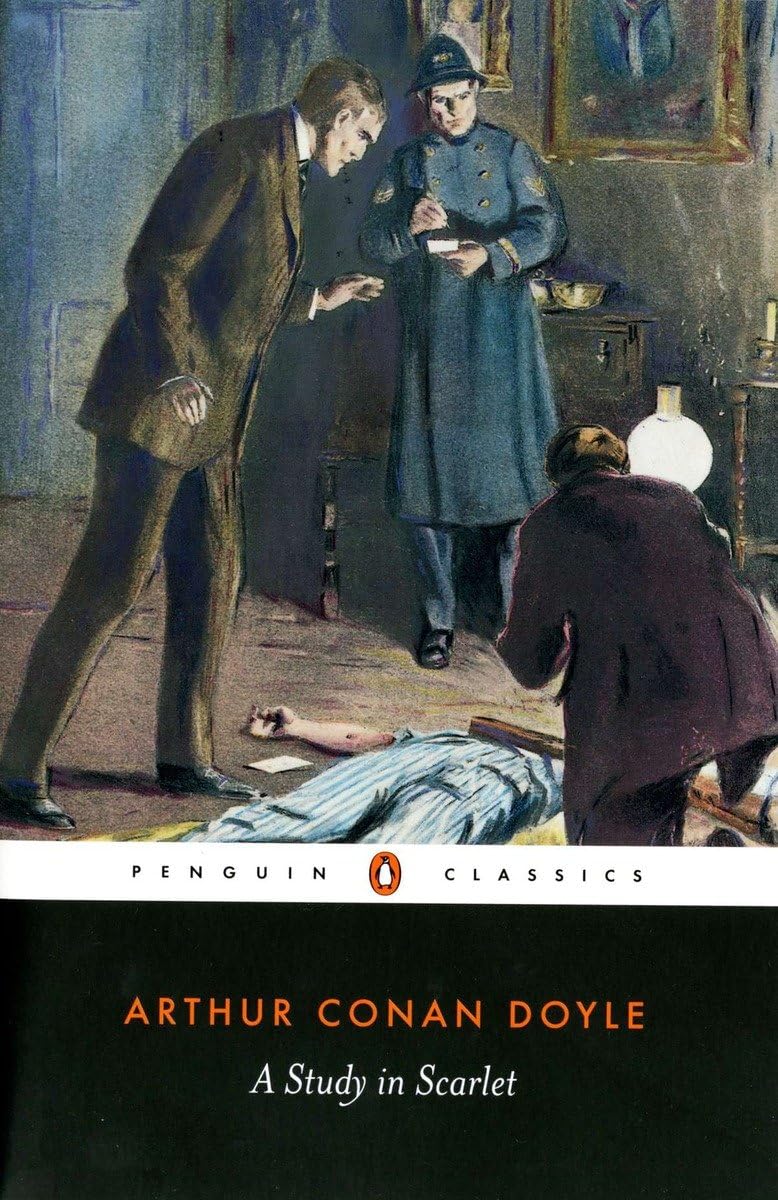
A Study in Scarlet(1887)
Γιώργος ΜπαρουξήςArthur Conan DoyleΓιώργος-Ίκαρος Μπαμπασάκης
Goodreads
4.13
496K VotesReadings
Our first meeting with Sherlock Holmes. And it's John Watson's too! They meet at the start of this novel, and the young doctor is astonished by Holmes' many idiosyncrasies including his talents on the violin.
But it's not long before Sherlock Holmes, with Watson in tow, is working with Scotland Yard investigating the murder of two Americans whose deaths have some mysterious connection to sinister groups gathering power in both Britain and America.
Here's where it all began - 'A Study in Scarlet.' Meet Sherlock Holmes, one of the world's leading consulting detectives - fictional of course!
Infos
Pages
123
123
Format
Paperback
Paperback
Language
English
English
People Finished
4
4
Published By
Digireads.com
Digireads.com
Published at
12/27/1887
12/27/1887
Isbn13
9781420925531
9781420925531
Isbn10
1420925539
1420925539
Setting
London, England (, 1881), Utah (United States, 1847), Salt Lake City, Utah (United States)
London, England (, 1881), Utah (United States, 1847), Salt Lake City, Utah (United States)
More from Γιώργος Μπαρουξής
Sherlock Holmes Series
BOOK 1
8.26
Book
A Study in Scarlet
BOOK 2
7.76
Book

The Sign of Four
BOOK 3
8.60
Book

The Adventures of Sherlock Holmes
BOOK 4
8.58
Book

The Memoirs of Sherlock Holmes
BOOK 5
8.28
Book

The Hound of the Baskervilles
BOOK 6
8.54
Book

The Return of Sherlock Holmes
BOOK 7
7.92
Book

The Valley of Fear
BOOK 8
8.46
Book

His Last Bow
BOOK 9
8.22
Book

The Case-Book of Sherlock Holmes
BOOK 1-2
8.26
Book
A Study in Scarlet and The Sign of Four
BOOK 1-9
9.02
Book

The Complete Sherlock Holmes
BOOK 1-9
9.02
Book

The Complete Sherlock Holmes
BOOK 3-4
8.64
Book

The Complete Adventures and Memoirs of Sherlock Holmes
BOOK 3-6
9.00
Book

The Original Illustrated Sherlock Holmes
BOOK 8-9
8.10
Book

His Last Bow & The Case-Book of Sherlock Holmes
Reviews
aleks-predator
10 months ago
8
The birth of a great detective
In 1887, Arthur Conan Doyle presented the world with one of the most iconic literary characters — Sherlock Holmes, who will make his debut in the book "A Study in Crimson Tones". This work is not only the beginning of the famous cycle, but also lays the foundation for the genre of detective literature, combining a sharp mind and a scientific approach to solving crimes.
The main theme of the book is the clash of reason and evil, where Holmes, with his outstanding analytical abilities, becomes a symbol of order and intelligence in a world of chaos. Conan Doyle introduces the reader to the world of Victorian London, where crimes become puzzles that only a brilliant detective can solve. An important part of the work is the contrast between Holmes' scientific method and the traditional methods of investigation used by his colleagues at Scotland Yard.
Separately, it is worth noting the interaction between Holmes and Dr. Watson, which begins in this work. Watson, as a narrator, helps to delve into mysteries with Holmes, admiring his insight, and also serves as a kind of bridge between the brilliant detective and ordinary people.
The investigation itself, related to the mysterious murder, impresses with its structure and attention to detail. Conan Doyle builds an interesting plot, gradually bringing the reader to the solution.
The finale of the book, as expected, demonstrates the power of Holmes's mind, but at the same time leaves behind important moral questions about justice and retribution. The book offers not just a solution to the puzzle, but also a reflection on what motivates criminals, and at what cost people achieve their revenge.
"A Study in crimson tones" is a classic work that not only captures with its detective story, but also immerses into the complex world of human emotions and motives. The beginning of the legend of Sherlock Holmes in this book promises an exciting journey for those who appreciate intellectual stories full of mysteries and surprises.
8 out of 10
Different Editions
Collections
Nothing here
¯\_(ツ)_/¯