








Foundation(1951)
Isaac AsimovJorge Colaço
Goodreads
4.17
602K VotesReadings
No readings yet. Add one to start tracking.
The first novel in Isaac Asimov's classic science-fiction masterpiece, the Foundation series
For twelve thousand years the Galactic Empire has ruled supreme. Now it is dying. But only Hari Seldon, creator of the revolutionary science of psychohistory, can see into the future--to a dark age of ignorance, barbarism, and warfare that will last thirty thousand years. To preserve knowledge and save humankind, Seldon gathers the best minds in the Empire--both scientists and scholars--and brings them to a bleak planet at the edge of the galaxy to serve as a beacon of hope for future generations. He calls his sanctuary the Foundation.
Infos
Pages
244
244
Authors
Format
Hardcover
Hardcover
Language
English
English
People Interested
3
3
People Reading
1
1
People Finished
2
2
Published By
Bantam
Bantam
Published at
8/30/1951
8/30/1951
Isbn13
9780553803716
9780553803716
Isbn10
0553803719
0553803719
More from Isaac Asimov
Foundation (Publication Order) Series
BOOK 1
8.34
Book
Foundation
BOOK 2
8.44
Book

Foundation and Empire
BOOK 3
8.56
Book

Second Foundation
BOOK 4
8.38
Book

Foundation's Edge
BOOK 5
8.14
Book

Foundation and Earth
BOOK 6
8.34
Book

Prelude to Foundation
BOOK 7
8.32
Book
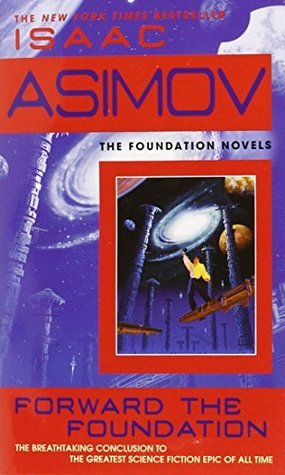
Forward the Foundation
Shelve Foundation's Friends
8.38
Book

Foundation's Friends
BOOK 1-3
8.84
Book

The Foundation Trilogy
BOOK 1-7
9.14
Book

The Foundation Novels 7-Book Bundle: Foundation, Foundation and Empire, Second Foundation, Foundation's Edge, Foundation and Earth, Prelude to Foundation, Forward the Foundation
Reviews
aleks-predator
11 months ago
9
"Violence is the last refuge of the incompetent"
"Foundation" by Isaac Asimov is a landmark work of science fiction that launches one of the genre’s most iconic sagas. The story unfolds in a distant future where a vast Galactic Empire, long dominant over all of humanity, stands on the brink of collapse. A scientist named Hari Seldon develops a unique science — psychohistory — which uses mathematics and statistics to predict the future of entire civilizations. Realizing that the Empire’s fall is inevitable, he initiates the Foundation project — a special scientific community on the edge of the galaxy, created to preserve knowledge and shorten the dark age that will follow the Empire’s demise.
The book consists of several interconnected novellas, each covering a different time period and focusing on a key stage in the Foundation’s development. These are like milestones in history — every chapter presents a new situation, new characters, and new challenges. At first, psychohistory may seem bizarre and overly fictional, especially since Asimov never explains how it actually works. There are no equations, no calculations — just logic, faith in science, and intelligent dialogue. Yet it’s through these dialogues that the author conveys the core idea: how one might calculate the behavior of large groups of people and use the past to make predictions about the future.
The deeper you read, the less you want to question the scientific assumptions. The story becomes more gripping with each chapter, each novella falling neatly into place as part of a greater vision. Asimov writes vividly and engagingly, and despite the heavy presence of scientific and political themes, the book reads effortlessly. He manages to build a world that feels logical, thoughtfully constructed, and genuinely epic.
I also want to highlight how skillfully Asimov ties the novellas together into a coherent whole. At first, they may seem like standalone stories, but at some point, it becomes clear: everything that happened matters. Everything is connected, everything has weight. And the themes he touches on — power, knowledge, societal systems — remain just as relevant today in the 21st century. I’m confident they’ll still resonate a hundred years from now.
The first "Foundation" turned out to be exactly what I was hoping for. I had heard a lot about the book, knew of its acclaim, and was glad to see for myself that it truly is an outstanding work — one that fascinates with its ideas and compelling storytelling. A brilliant piece of science fiction that every fan of the genre should read.
9 out of 10